Context & challenge
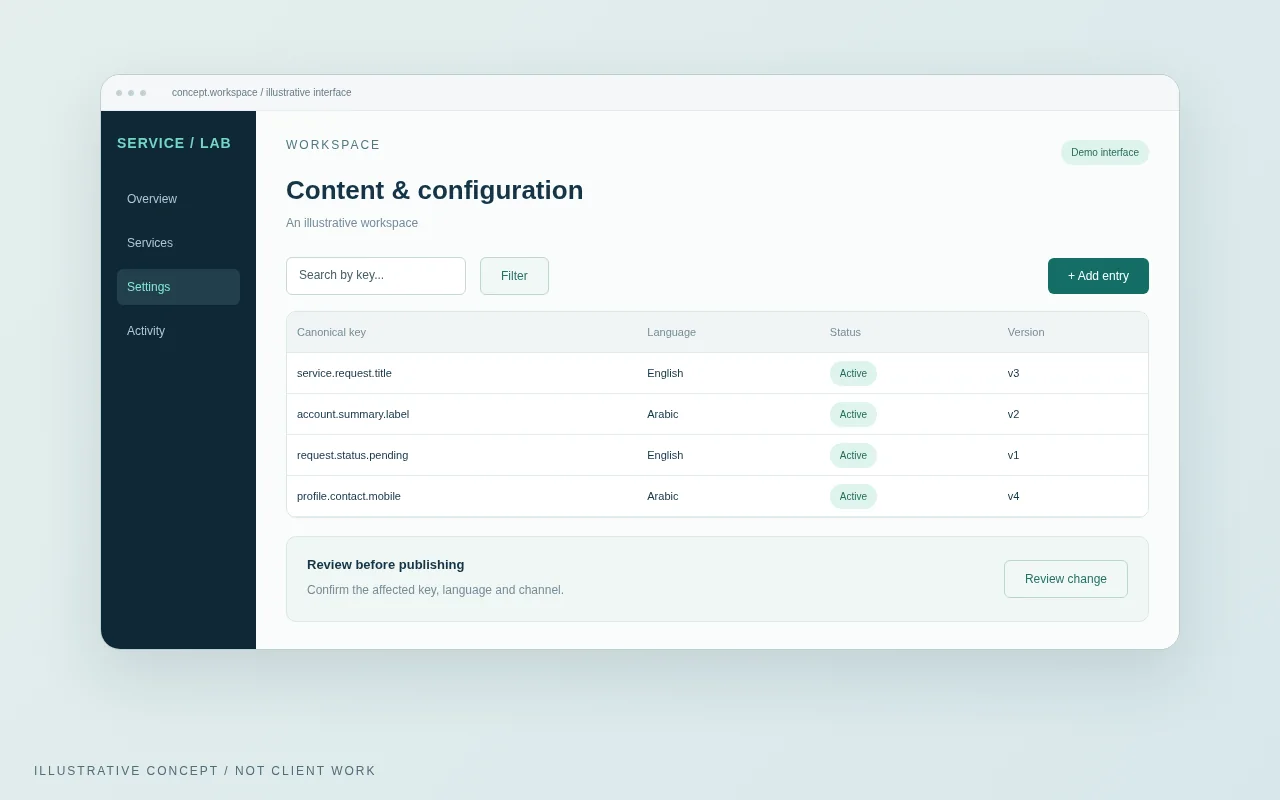
Imagine an operations team managing shared content and configuration across channels. This concept explores safer editing, clearer filters and a review step before changes are published.
Role & collaboration
A real version of this case study should distinguish decisions I owned, work I reviewed and contributions made by the team. For this example, the proposed scope spans UX direction, UI review and front-end collaboration.
Evidence to collect
- Customer or operator interviews: record the problem in their own words.
- Journey or task review: identify the moments that cause uncertainty.
- Technical and service constraints: document what the design cannot change.
Decisions & trade-offs
Separate editing from publishing
Offer a review step showing the affected key, language and channel. Trade-off: an extra step when the change has consequences.
Expose version history as read-only
Make the latest change easy to inspect without placing audit metadata among editable fields.
Design direction
Making configuration changes understandable, reviewable and reversible. The visual is an illustrative interface, not a screenshot of an NWC system.
Starting point / hypothetical
Editing and publishing are combined in one action.
Proposed direction / concept
Draft, review and publish are distinct and understandable.
Validation & outcomes
No outcome is claimed for this sample. Replace this section with a baseline, comparison period and verified results before publishing it as real work.
Reflection
In a real study, end with the decision that changed after testing, what the team learned and what still needs work. Do not present the concept as a validated result.
Back to all work